
What to Pack for a Multi-Day Hike with Your Dog: A Complete Packing List
August 28/2026
We set out on a multi-day trek with our dog with the goal of sleeping under a tarp or in a bivouac, and we cooked our own dehydrated meals, which really put our gear to the test.
In this article, you’ll find our own packing list and everything we learned along the way. May your first (or tenth) multi-day trek with your dog go as smoothly as possible.
What Is a Multi-Day Hike with a Dog
A multi-day trek is any hike that lasts longer than 24 hours and includes at least one overnight stay. Some people stay in cabins or guesthouses along the way, but in this article we’re talking about “wild camping”, spending the night in the great outdoors, away from civilization and away from cabins where you can’t buy food or drinks.
We’re not talking about month-long or week-long mountain crossings, nor about a classic “thru-hike” along a marked long-distance trail. We’re talking about a few days in the high mountains, when you really have to carry everything on your own back, which makes planning your gear all the more important.
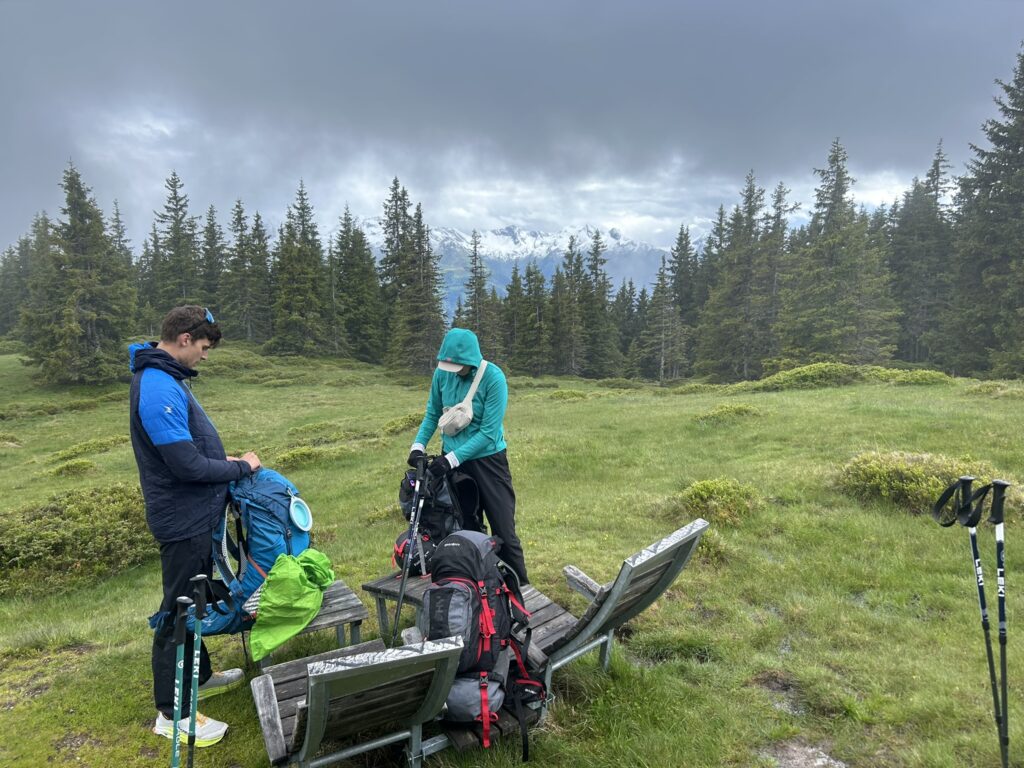
What to Wear
We’ve found it helpful to think of clothing as a system of layers that you can add or remove depending on the weather and the intensity of your hike.
Since outdoor gear isn’t cheap, our layering setup isn’t exactly textbook, but we make do as best we can. Start with a lightweight, quick-drying T-shirt or thermal layer next to your skin, and top that with a sweatshirt depending on the weather. For the outer layer, we bring a hybrid jacket, along with gloves, a hat, and a multifunctional scarf, which comes in handy for everything from protecting your neck to wiping away sweat.
As a general rule, the more trekking experience you have, the fewer clothes you’ll end up bringing: even for a multi-day trek, two T-shirts, one pair of pants, a pair of shorts, and one sweatshirt were enough for us.
Don’t underestimate the value of a quick-drying towel either. We found that two smaller towels worked well for us. One to dry off, and one to wipe down the dog after rain or mud.
Gear You Really Need
Gear for a multi-day trek with a dog can be divided into five main categories:
- Food and drink – enough supplies for the entire trek, ideally light and high in energy, plus a water filter for stream water (we don’t have one yet, but we recommend it).
- Clothing – the layering system described above, adapted to the season and elevation.
- Safety and navigation gear – maps, a power bank, a first-aid kit, and everything you need if something goes wrong.
- Sleeping gear – a tarp or tent, sleeping pad, sleeping bag, and the Tyvek sheet we’ll discuss below.
- Dog gear – harness, leash, food, and other specific gear.
Our Sleeping System
A tarp (or tent), sleeping bag, sleeping pad, and Tyvek are the four items that determine how well you’ll sleep in the mountains.
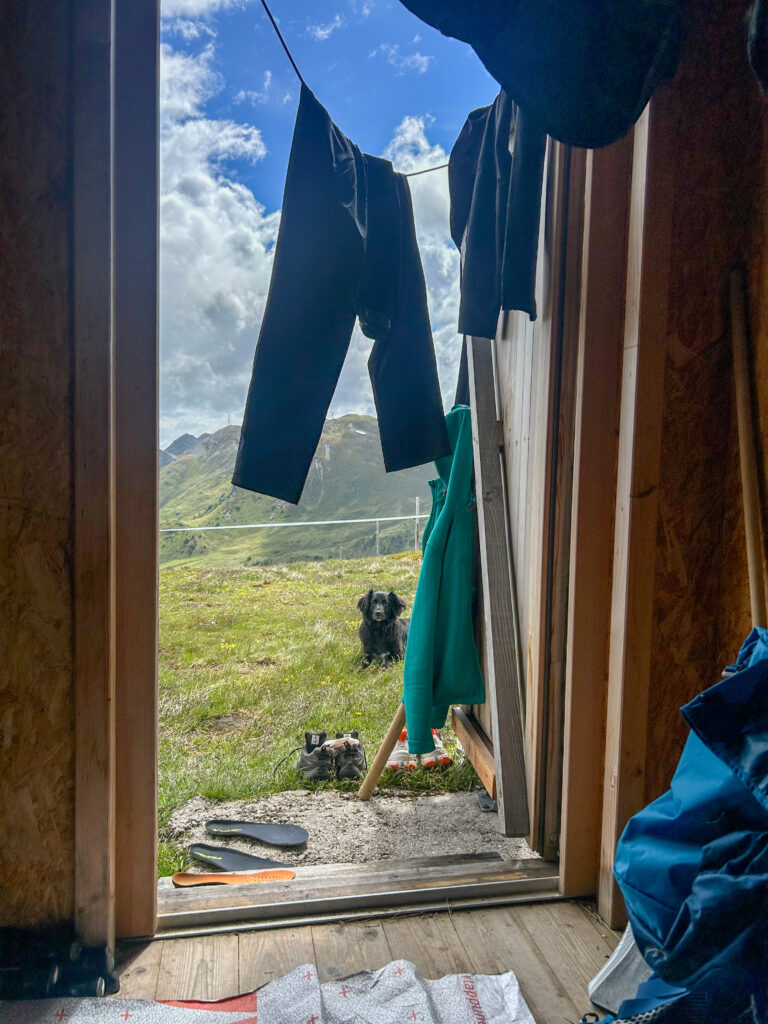
For the first time, we opted for a tarp instead of a traditional tent. Compared to a tent, a tarp can accommodate more people and is also cheaper, so it’s a good choice if you don’t mind a bit of improvisation and know how to pick a suitable spot to sleep. Always bring a rope to set up the tarp; without it, you won’t be able to tension it properly. Also, keep in mind that you’ll need trekking poles for the tarp. We bring them on multi-day hikes anyway, since they take a lot of the strain off your legs and help you maintain your posture while walking.
We got some Tyvek (roof insulation) to use under our sleeping pads. It works similarly to expensive outdoor tent pads, but at a lower cost and with worse puncture resistance. When it comes to sleeping pads, one of the most important things to consider it’s R-value, a measure of how effectively it insulates you from the cold ground. The higher the number, the better the insulation, which makes a significant difference in the mountains. A sleeping pad isn’t just about comfort, proper insulation can be crucial for staying warm and getting a good night’s sleep, especially in colder conditions.
In addition, we brought a sleeping bag chosen based on the temperature range we’d be facing, and a small inflatable pillow, which significantly improved our sleep quality. From our own experience, we recommend bringing a warmer sleeping bag than you think you’ll need. It tends to get colder at night in the mountains than you might expect.
For now, we’ve been handling our dog’s sleeping arrangement by covering the sleeping pad with a towel and placing the dog between us so we can all stay warm. However, it’s definitely a good idea to get one of these options for your dog.
How We Cook Meals on the Trail
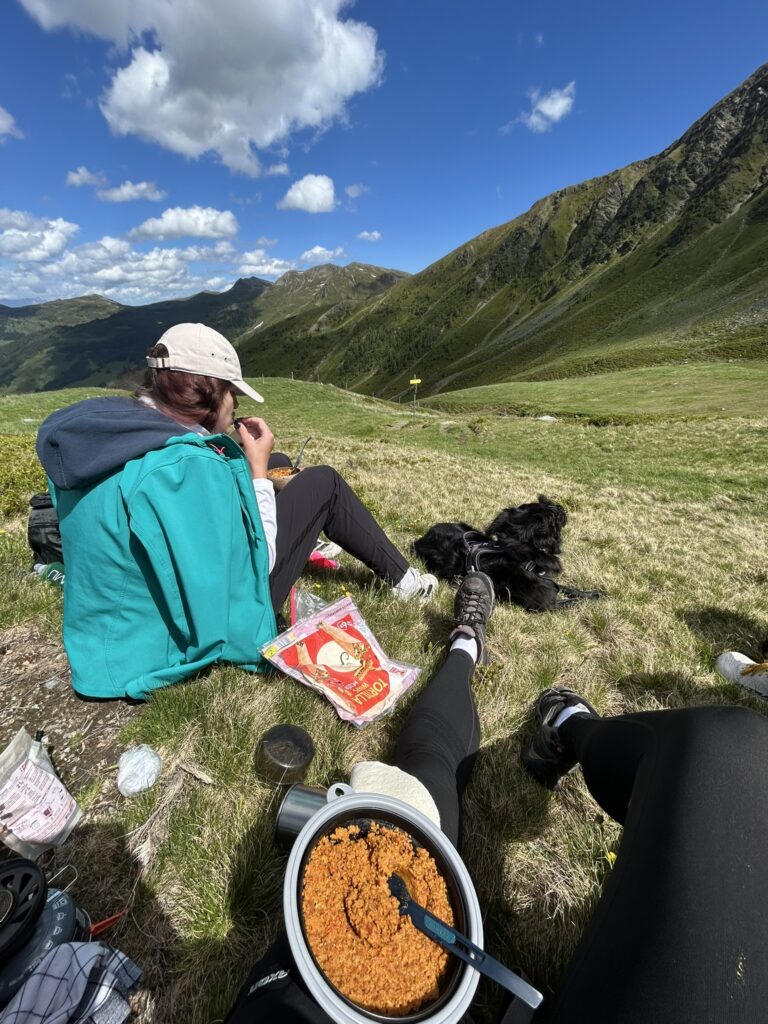
A hot meal replenishes calories, restores energy, lifts your spirits after a full day of hiking in the mountains, and warms you up in the evening. The solution is a simple stove connected to a gas cartridge, which just requires a mug or bowl, a spoon/fork (spork), and a lighter. It’s also a good idea to carry matches.
We also prepare our own food for treks. At home, we dehydrate our own meals (from pasta or rice mixes to vegetables and meat), which just need to be doused with boiling water and left to sit for a few minutes while on the trek. It’s cheaper than store-bought expedition meals, can be tailored exactly to our tastes, and we know exactly what’s in the food. All you need for cooking is water, a gas stove, and a little patience. To speed things up, we recommend a rapid-boiling stove, such as a JetBoil.
How Much Should Your Backpack Weigh
It’s tempting to bring everything “just in case,” but an unnecessarily heavy backpack will ruin your experience faster than anything else. A sore back and shoulders aren’t what you want to deal with on your second day in the mountains.
It pays to pack efficiently and take only what you’ll actually use. When you’re spending a few days in the backcountry, many things you take for granted at home (a change of clothes for every day) aren’t necessary on a trek. The typical weight of a backpack for a multi-day trek, without extreme weight reduction, ranges from about 15 to 20 kg per person, even including equipment for a dog, which you’ll split among yourselves.
How to Reduce the Weight of Your Backpack
Your sleeping gear is the heaviest and bulkiest item in your backpack, so it’s also the best place to start saving grams. Even a small investment in a lighter sleeping pad or sleeping bag can make a noticeable difference in weight.
Another simple trick: divide your dog’s gear evenly between both backpacks, not just one of you. And instead of spending money on the most expensive ultralight gear, start by getting rid of what you don’t actually use. For us, that meant extra clothes “just in case,” which we ended up carrying for no reason. You can also lighten your pack by buying a dog backpack, so your dog can carry its own things on its back.
Dog Gear
Dog gear for a multi-day hike has its own set of rules. Here’s what we packed for Gina (a medium-sized breed):
- Harness – we chose a comfortable trekking harness. On challenging terrain and when climbing over obstacles, it’s safer and more practical because you can easily hold or lift the dog if necessary.
- Belt – During technical sections when you need both hands to hold on while keeping the dog under control, it’s a good idea to get a running belt or harness to which you can attach the leash.
- Leash – a version with a shock absorber (rubber) that cushions impacts.
- Blanket – Even under a tarp, a dog blanket or pad makes a huge difference in how warm your dog stays at night.
- Paw wax – on rugged mountain terrain, paws wear down quickly. We applied the wax before more challenging sections, and it significantly reduced chafing.
- Bowl – a lightweight, collapsible bowl for water and food that you can attach to the outside of your backpack.
- Food – Make sure you have enough food for the entire trek, plus a reserve. We prefer lighter kibble with a higher energy content so the backpack isn’t unnecessarily heavy.
- Raincoat – The weather in the mountains can change in an instant, so we consider a raincoat for your dog to be essential gear.
Gina doesn’t have the dog backpack yet, so we carry all her gear. When planning your backpack’s weight, be sure to factor this in, dog food for several days takes up more space and weighs more than you might expect.
Packing list for a multi-day trek with a dog (download / screenshot)
- 60–70 L backpack
- trekking poles
- shoes (we’ve come to prefer trail running shoes)
- dehydrated meals (homemade or store-bought) for the entire trek
- breakfast / instant porridge, coffee
- snacks for the day (energy bars, dried fruit, nuts)
- extra emergency food supply
- gas stove or portable stove (e.g., JetBoil) + fuel cartridge
- lighter + matches
- mug/bowl + spork
- water bottles, hydration pack
- water filter (recommended)
- 2 T-shirts (one for hiking, one for evenings)
- thermal T-shirt
- sweatshirt / fleece
- hybrid or waterproof jacket
- spare pants / shorts
- gloves, hat, multifunctional scarf
- 2 quick-drying towels
- poncho (protects you and your backpack from the rain)
- tarp or tent + stakes + guy line (don’t forget!)
- sleeping pad + Tyvek (roof insulation)
- sleeping bag (better to choose one that’s warmer than you expect)
- inflatable pillow
- offline maps / navigation – printed map as well
- power bank + cable
- headlamp
- safety whistle
- first aid – plasters, painkillers, antihistamine pills and basic medical supplies
- emergency blanket / bivouac
- toilet tissue, hand sanitiser
- hiking harness
- Running belt/harness for technical sections
- Leash with shock absorber
- blanket / sleeping pad (or towel + sleeping next to you)
- paw wax
- folding bowl
- Food for the entire trek + extra
- raincoat for the dog
Newsletter
Signup for news and special offers!
Thank you!
You have successfully joined our subscriber list.
Contact Us
Passionate about the outdoors? So are we. Reach out to share a route, collaborate, or simply say hi.