
Downhill a uphill:
what happens to muscles and joints when moving in the mountains
If you run or hike in the mountains, you have probably noticed that your body reacts completely differently than it does on flat ground. How do the movements differ, and which muscles do I use? What happens to the body when climbing uphill and descending downhill?
I am preparing for my first ultramarathon, and while creating my training plan, I started asking myself these questions. I was curious why climbing tires the muscles differently than moving on flat ground and why there are so many DNFs (did not finish) in trail races, causing such muscle fatigue.
I decided to do a little research from scientific articles to understand the biomechanics, physiology, muscle activity, and differences in movement. In my opinion, this is key to putting together a quality training program.
If you don’t want to read the whole article, all you need to know is THIS
How the body reacts when walking and running on flat ground vs. uphill
As a beginner in trail running, I wanted to better understand why running or walking uphill is so different from moving on flat ground. I wasn’t just interested in the feeling that it’s harder, but mainly in what actually happens in the body from a physiological and biomechanical point of view.
Moving uphill is much more energy-intensive
The biggest difference between flat ground and uphill is that when walking or running uphill, the body is not only moving forward, but also has to overcome gravity and lift itself against it. This requires more mechanical work and therefore higher energy expenditure and oxygen consumption compared to moving on flat ground. Moving uphill is therefore significantly more demanding.
Another thing that caught my attention is the difference in muscle activation:
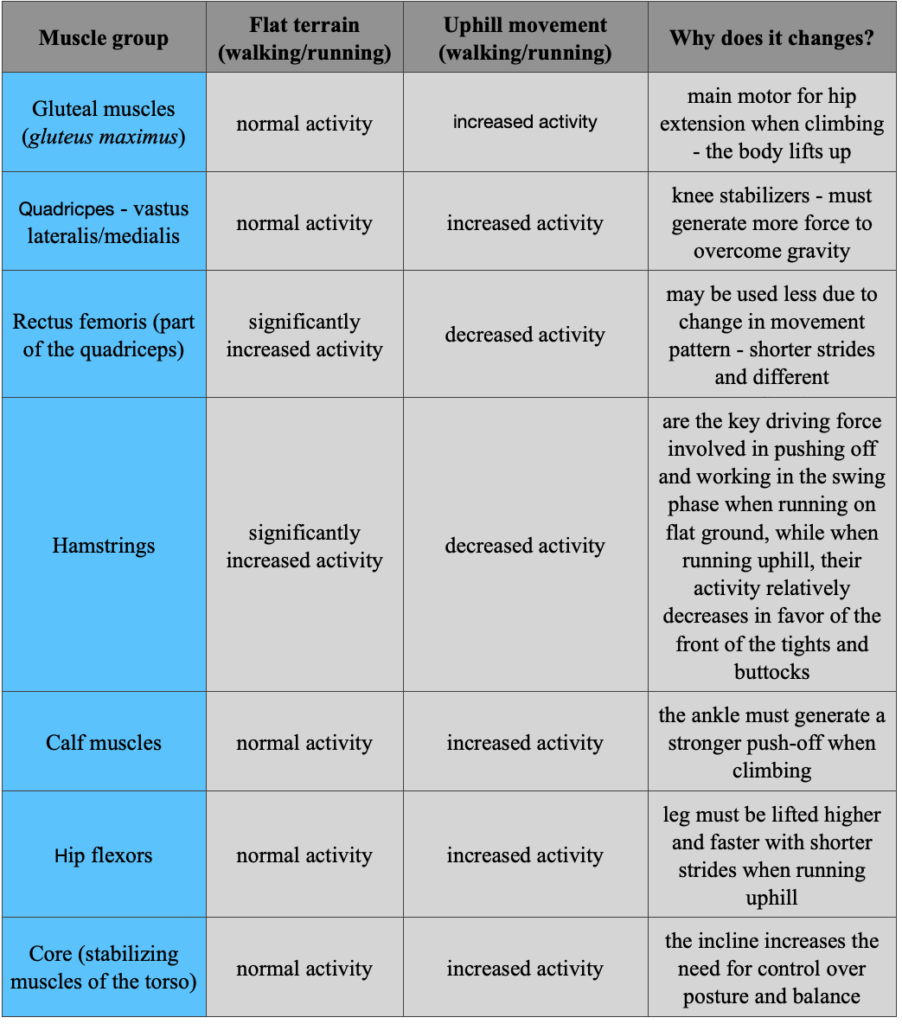
When moving uphill, the body has to exert more force when pushing off, so all the large muscle groups in the legs are more involved:
- gluteal muscles
- thigh muscles (especially the front – quadriceps and back – hamstrings)
- calf muscles
The activity of these muscle groups is significantly higher compared to running on flat ground, while on flat ground the work is much more economical and focused primarily on maintaining forward momentum. When climbing, the body redistributes the work, which is why some muscles are less strained than when running on flat ground, for example, m. rectus femoris (part of the quadriceps) or m. semitendinosus (hip joint muscle).
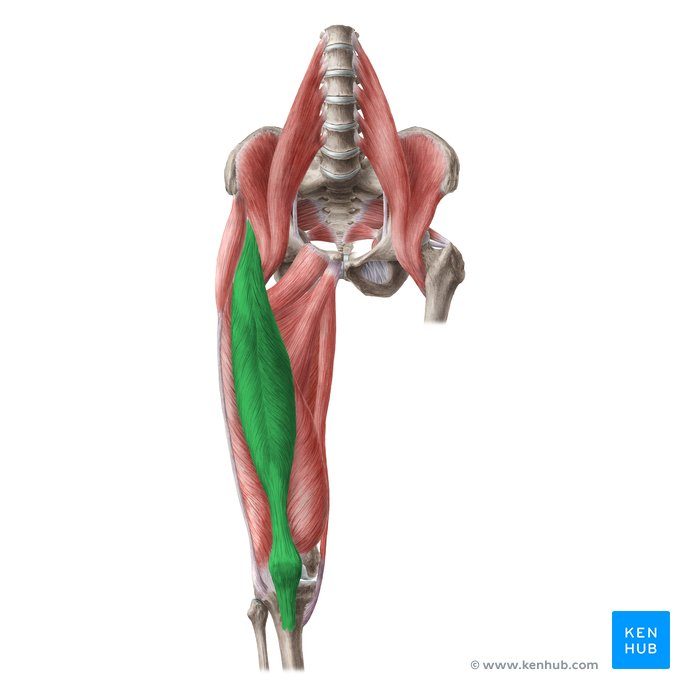
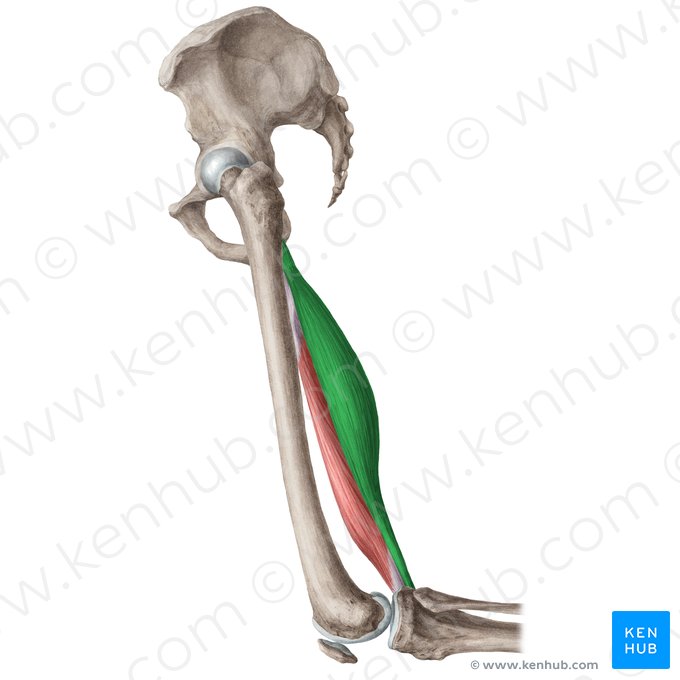
Moving uphill also changes the biomechanics of your stride
When moving uphill, not only does the physiological load change, but so does the biomechanics of your stride. When climbing, the body naturally adapts to the slope of the terrain. The length of the step is shortened, the frequency of foot strikes is increased, and the time the foot is in contact with the ground (the duty factor) is extended, while the phase in the air is shortened (the swing phase). This way of moving helps maintain stability on the slope and use energy more efficiently when moving.
At the same time, the way joints and muscles generate movement also changes. When walking or running uphill, there is greater flexion in the hip and knee, especially during the support phase of the step. The muscles of the lower limbs thus work in a greater range of motion and must exert more force to lift the body against gravity. This biomechanical change increases the demands on muscle work and contributes to the higher energy intensity of uphill movement compared to movement on flat ground.
How the body reacts differently when walking and running downhill
When I started running in the mountains and getting more involved in the trail running community, I began to notice that running downhill is often the reason why people don’t finish races (DNF – did not finish). I wanted to prevent this and find out as much as possible about how downhill running affects the body, whether I’m running or walking.
Dominance of eccentric muscle contractions
The most important thing I discovered is that when moving downhill, whether running or walking, the muscles work predominantly eccentrically. This means that they lengthen under tension, slowing down movement and cushioning the impact.
The front of the thighs (quadriceps) is the main muscle group that regulates the speed at which we move downhill. When we move downhill, gravity naturally pulls us down, and the body tends to descend faster with each step. To prevent the impact from being too hard and uncontrolled, the quadriceps act as brakes.
This is done through eccentric muscle work. Eccentric contraction occurs when a muscle lengthens under tension. Instead of propelling the body forward as it does when running uphill, the muscle acts as a brake, absorbing the energy supplied.
In this case, energy absorption means that the muscles absorb part of the impact and prevent all the force from being transferred directly to the joints. The quadriceps thus protect the knees and help maintain stability when running downhill. At the same time, however, eccentric work is very demanding, causing minor micro-damage to muscle fibers, which explains the typical muscle fatigue and pain.
Biomechanics of downhill movement
When running or walking downhill, the body’s movement changes significantly in terms of biomechanics compared to running on flat ground. On flat ground, the body works to move forward efficiently. When running downhill, it is more about controlling the impact than the forward movement itself. This means that the muscles of the lower limbs perform so-called negative mechanical work, which means that instead of creating it, they have to process it.
There is also a difference between running and walking. When running, the impacts are harder and more frequent, so the body has to react faster. When walking, the movement is slower, but the descent often takes a long time and involves many steps, so even walking can lead to significant fatigue in the thighs.
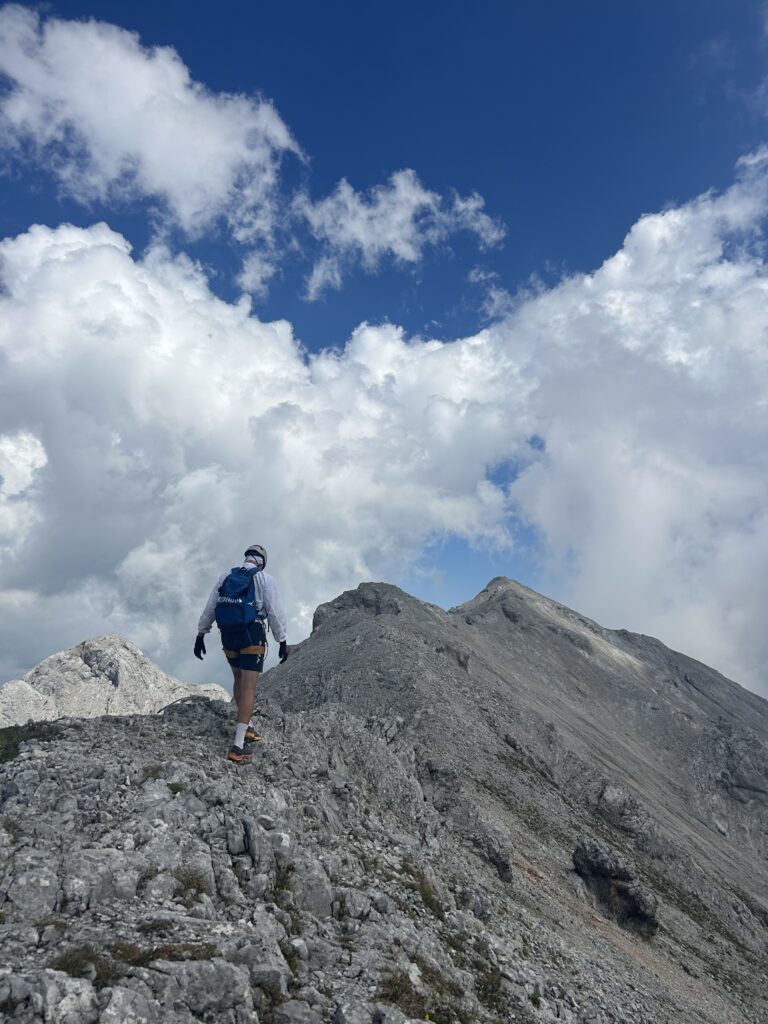
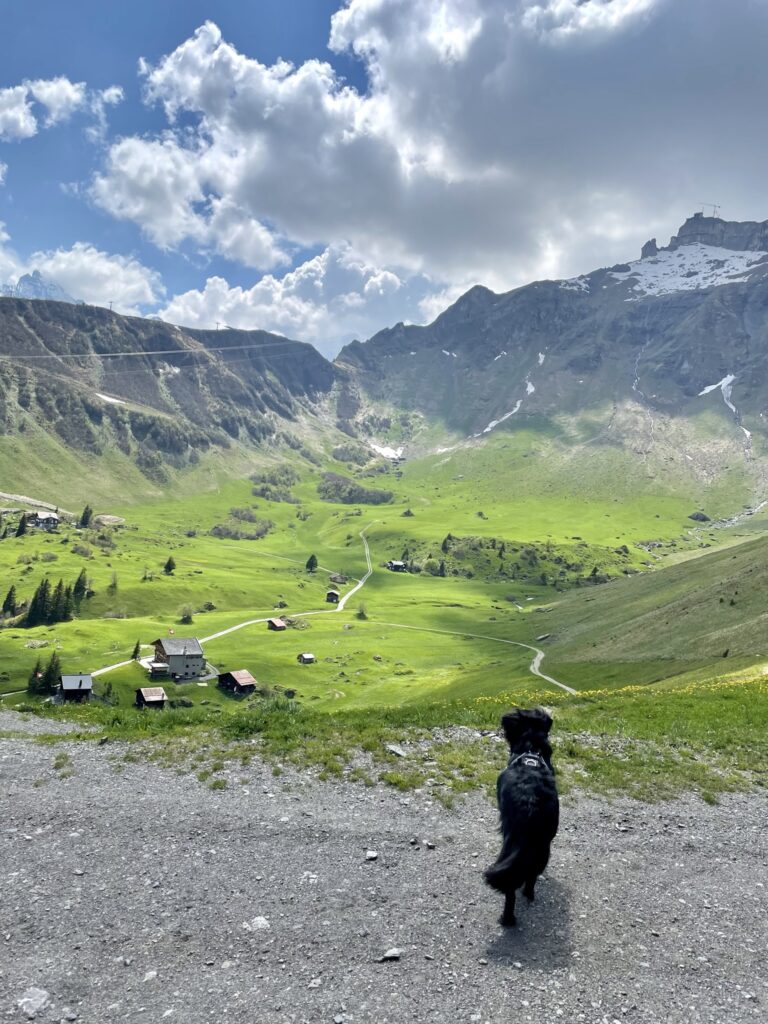
Moving around in the mountains puts different strains on the body depending on whether we are going uphill, downhill, or on flat ground.
- Uphill: When climbing, the muscles, mainly the quadriceps, glutes, and calves, work concentrically. This means that as they shorten, they propel the body upward. It is physically demanding, but the muscles usually work without major micro-damage.
- Downhill: When moving downhill, the quadriceps and other lower limb muscles work eccentrically. The muscles lengthen under load and act as brakes to control the speed of impact. Micro-damage to muscle fibers is much greater than when going uphill due to energy absorption. Biomechanically, the joints and muscles are exposed to greater negative work and repeated stress, which explains why downhill is often a critical moment in races.
- Flat terrain: When moving on flat terrain, the muscles work evenly and efficiently. They help us push forward and stabilize the body without extreme eccentric stress. Fatigue and pain are therefore less than when climbing or descending.
Overall, each type of movement puts a different strain on the body. In my opinion, a proper understanding of the differences is key to better training planning. This allows us to protect our muscles and joints and minimize unnecessary fatigue or risk of injury.
Sources
Newsletter
Signup for news and special offers!
Thank you!
You have successfully joined our subscriber list.
Contact Us
Passionate about the outdoors? So are we. Reach out to share a route, collaborate, or simply say hi.