
How to plan a hike with your dog
A complete guide to hiking in the mountains
Introduction
If you love the mountains and want to share your adventures with your four-legged friend, then this blog is for you. In this guide, we will show you how we choose dog-friendly routes and tackle difficult passages, share our lessons learned, and conclude with a list of the equipment we use.
Our advice is based on hundreds of kilometers in the European mountains, which we have traveled with our dog Gina. Gina is a mixed breed from a shelter, not an active breed, but she is proof that any dog can become a mountain enthusiast.
How we choose a dog-friendly route
After choosing a location, we start planning a specific route. We use the AllTrails app as a starting point. There you can find a large number of routes, including information on whether the route is suitable for dogs. We use it primarily as a first look at what the location looks like and what we can expect. We finalize the route in Mapy.com, which we believe offers clearer markings for water sources, peaks, signposts, and, most importantly, via ferrata and ladders directly on the route. And that’s key when planning with a dog.
What we pay attention to when choosing
Length and elevation gain
We always plan with a time reserve. We prefer to plan a route for seven to eight hours and finish it in six, rather than rush to catch up with the plan.
What length of a hike is even suitable for a dog? That is very individual. Gina is used to long routes. She can handle 20-25 km and about 1500 m of elevation gain. However, if it is your first time going to the mountains with your dog, we recommend starting with shorter route (10-15 km and a maximum of 800 m elevation gain) and adding more depending on your dog’s reaction. In our opinion, gradual adaptation is the key to success for every mountain dog.
Terrain
We check whether there are any via ferratas, ladders, or rope passages on the route. These are either impossible for dogs to navigate or require them to be carried, which is not ideal for medium and large breeds. These sections are either marked on Mapy.com or can be identified by a dotted line in combination with densely spaced contour lines. In these cases, it is a good idea to use Google Street View to decide whether the route is manageable with a dog.
Despite careful preparation, things don’t always go according to plan, so it’s always good to have a plan B. In the Dolomites, we had to completely rethink our three-day trek after the first 10 kilometers. Instead of the estimated four hours, we walked for eight hours. The terrain was much more challenging with Gina than we expected.
Water availability
This is especially important in summer. We look for streams, lakes, or springs on maps. If there is few water sources on the route, we have to expect to carry more for Gina, at least an extra liter. A dog should drink at least 40-60 ml per kilogram of body weight per day during physical activity. However, we expect her to replenish most of her fluids herself. She drinks from streams, lakes, and snowfields.
How we verify whether dogs are allowed
We always refer to the official websites of national parks and reserves, because that is where we can find all the information we need:
- Where dogs are allowed
- Where they must be kept on a leash
- Where they are completely prohibited
In the mountains, it is generally necessary to keep your dog under control, not only because of farm animals, but also because of wild animals, which dogs can disturb.
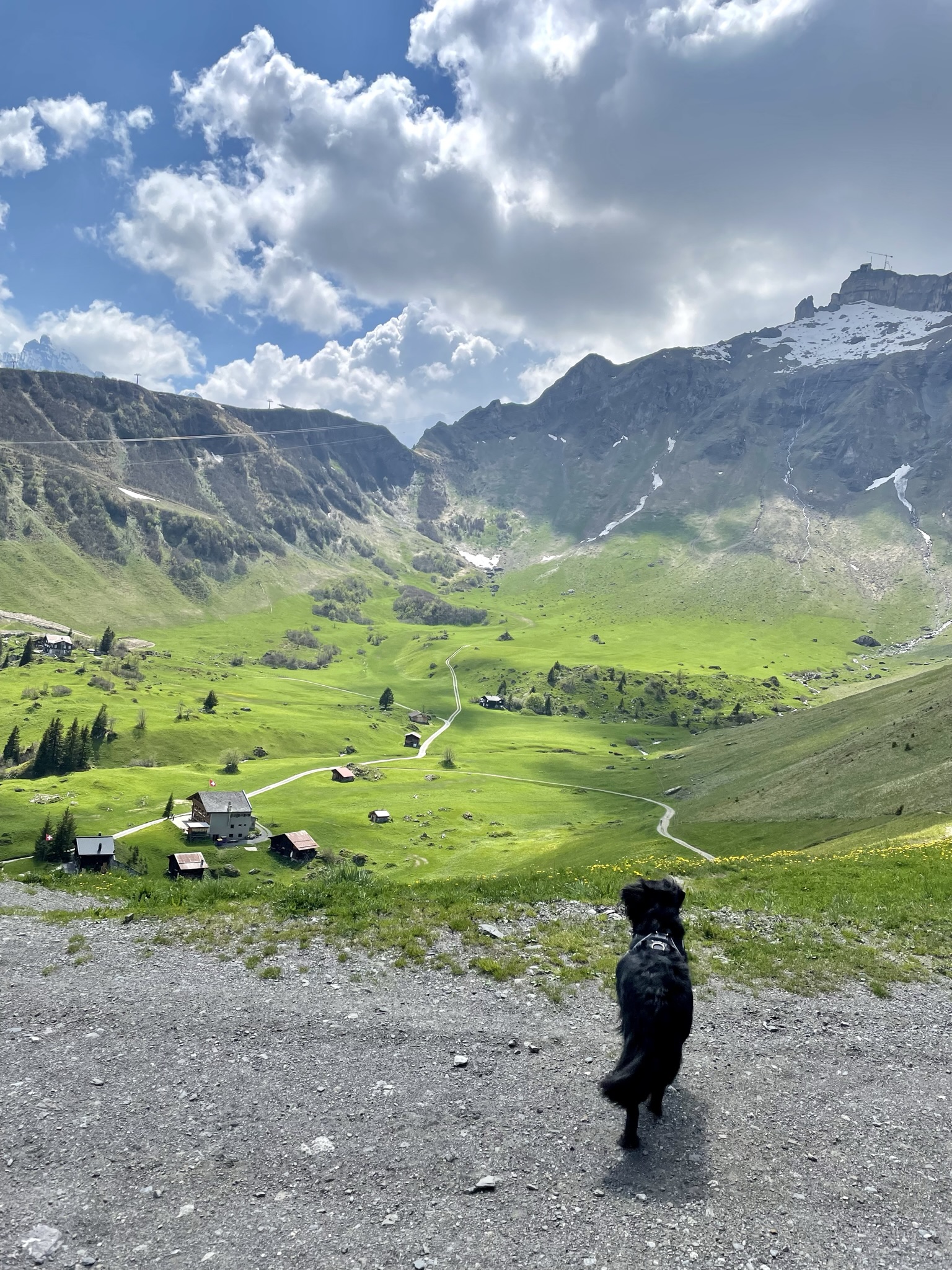
How to behave with a dog on a trek
How we operate on the route
We try to set off on mountain hikes before 7 a.m. This is not only because of afternoon storms, which are common in the Alps from 2 p.m. onwards, but also because of higher afternoon temperatures. These can be very dangerous, even fatal. That is why it is important to check your dog from time to time and take regular breaks. We take breaks roughly every 90-120 minutes. During breaks, we follow a simple rule: if we drink or eat, so does Gina.
On summer days, shade plays an important role, but it can sometimes be hard to find on a hike. That’s why we’ve learned a simple trick. Using our trekking poles and jackets, we build an improvised shake for Gina where she can rest.
How we deal with difficult passages
We identify technical and more demanding sections in advance using maps and elevation profiles, but despite careful planning, we are often surprised by something. When we encounter unsuitable terrain, one of us walks through the section first and assesses whether it is safe. If we think it is manageable, we simply attach Gina to her harness and let her handle the situation herself. In cases where the terrain is too dangerous (steep slopes and small debris under the wall), we show her safe footing and provide support in difficult sections. That is why we recommend carrying a dog evacuation backpack or carrier, such as the Wakytu C80-S, which can be very helpful not only in technical passages but also in case of injury. It allows you to carry your dog with ease, without straining its spine, while keeping your hands free for belaying or support in the terrain.
If you want to hike with your dog at an altitude above 2,000 m, expect more challenging terrain. In such cases, we believe it is necessary that the owner is physically capable of carrying their dog, at least for a short distance.
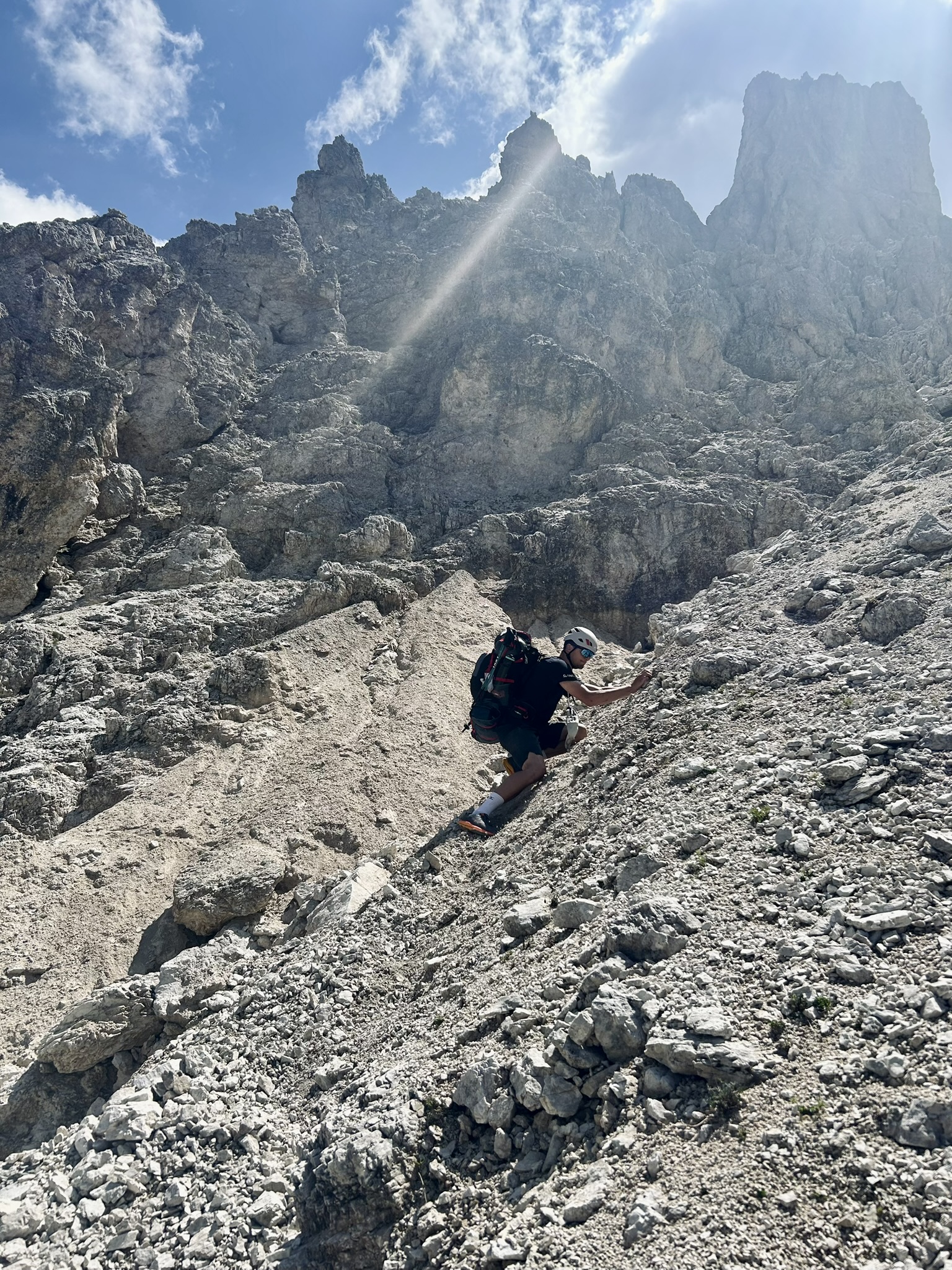
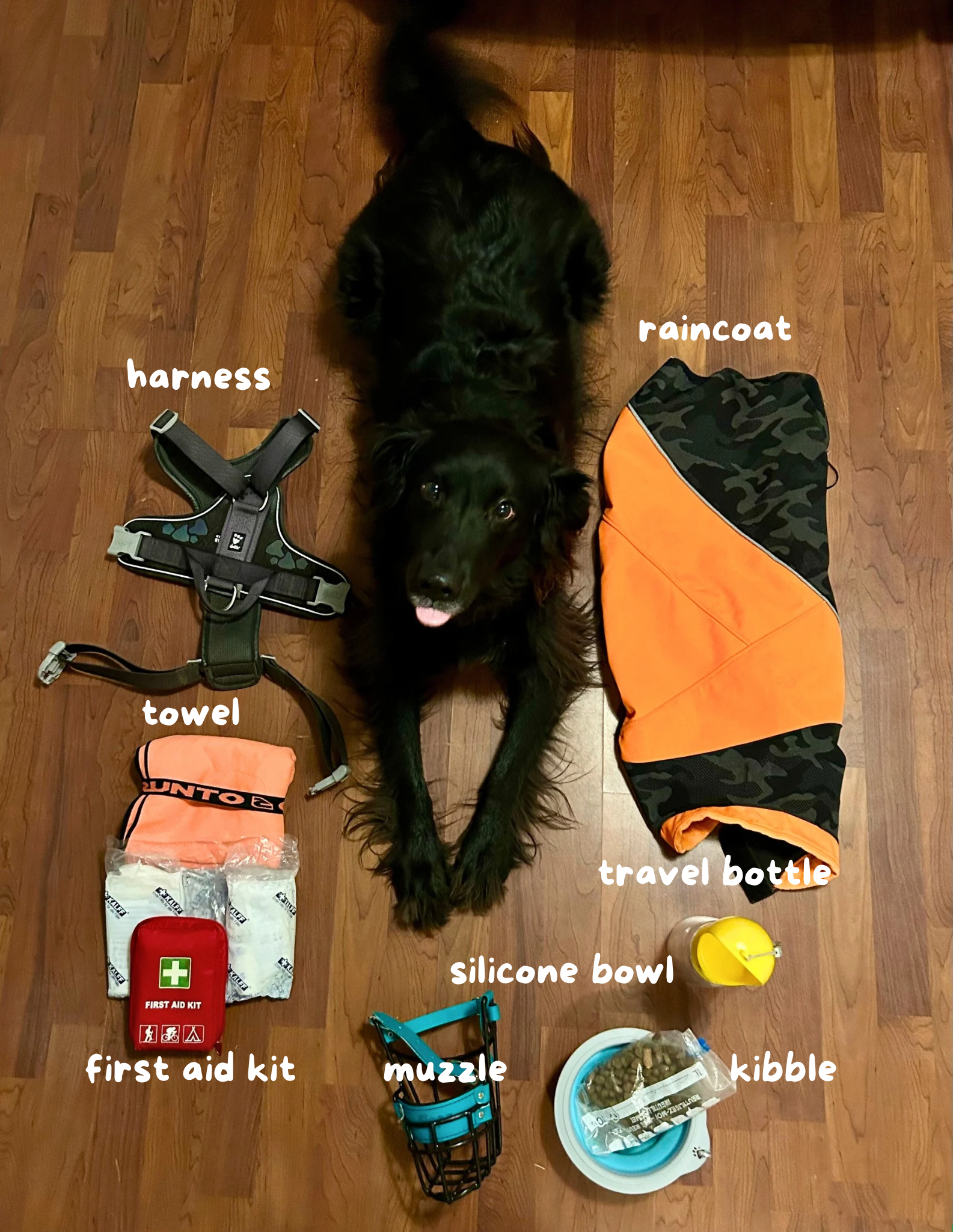
Essential equipment for dogs on a trek
Food
We divide the daily dose of kibble into bags, which saves space in our backpack and makes feeding easier on the go. When traveling, it’s easier for us to pour the bag directly into the bowl instead of estimating the right amount. We use the same kibble as we do at home. However, if you want to save space and a few grams, there are dehydrated food options, such as Only Natural Pet EasyRaw Dehydrated Dog Food. Treats are also important, as we use them as motivation during difficult passages.
Silicone bowl + travel bottle
For Gina, we pack a lightweight folding water bowl and a travel bottle, which is great if you need to save water. Any unused water can simply be returned to the bottle, as shown in the picture.
Harness and leash
Gina wears a Hurtta Weekend Warrior II, which is comfortable even on longer days.
Due to the requirement to keep dogs on a leash in the mountains, I use a Non-stop Dogwear aniX 2.0 running belt, which allows me to have my hands free and is comfortable even on long walks. If you are looking for a more affordable option, we have also had great success with the TRIXIE running belt with a shock-absorbing leash (approx. CZK 300).
Trail Dog Medical Kit
Our first aid kit contains tick tweezers, disinfectant, Coban, detoxification gel – Enterozoo, gauze, and two bandages in case of injury.
Raincoat
Even though the weather forecast is good, we always carry a raincoat for Gina just in case.
Muzzle
We always put muzzle on our backpack it weighs almost nothing and in case it is needed somewhere (at a cottage, in a cable car), it is better to be prepared than surprised.
Microfiber towel
A small microfiber towel is ideal for drying off after wading through streams, swimming in lakes, or in rainy weather. It is light, dries quickly, and takes up minimum space.
Conclusion
Hiking with a dog is a wonderful experience that has brought us with Gina even closer together. She has gone from being a city dog to a mountain enthusiast. She loves every climb, glacial lake, and grassy alpine meadow, where she likes to run freely and enjoy the views with us.
Not all trips went according to plan. The Dolomites were a huge lesson. Due to the steep slopes and rock structure, landslides are common in the Dolomites. Unfortunately, there was landslide before we went there and it was very difficult to find the correct way down. We set off without up-to-date information which could have prevented this. But every trip like this teaches us something new that we can pass on.
Newsletter
Signup for news and special offers!
Thank you!
You have successfully joined our subscriber list.
Contact Us
Passionate about the outdoors? So are we. Reach out to share a route, collaborate, or simply say hi.